

I’ve been tracking fitness technology for years and 2024 is different.
You’re probably overwhelmed by all the new gadgets and apps promising to transform your workouts. Smart rings, AI coaches, connected equipment. It’s hard to know what’s real and what’s just marketing.
Here’s the truth: most fitness tech is hype. But some of it actually works.
I spent months testing devices and analyzing what’s new in the market. Not the flashy stuff companies want you to buy. The tech that actually makes a difference in how you train and recover.
This guide covers the fitness technology advancements that matter right now. I’ll show you what’s worth your money and what you should skip.
We analyze emerging tech trends daily at fntkech tech updates by fitness-talk. We test real products and cut through the noise so you don’t have to.
You’ll learn about the latest wearables that go beyond step counting, smart equipment that’s actually smart, and AI coaching tools that might replace your trainer (or at least make them better).
No fluff about the future. Just what’s available today and whether it’s worth your attention.
The Evolution of Wearables: More Than Just a Step Counter
Your fitness tracker used to count steps and maybe track your heart rate if you were lucky.
Now it’s reading your blood oxygen levels and telling you whether you should hit the gym or take a rest day.
Here’s what changed.
Medical-Grade Sensors Go Mainstream
Five years ago, ECG readings required a doctor’s office visit. Today, your watch can do it while you’re sitting on the couch.
The Apple Watch got FDA clearance for its ECG feature back in 2018 (and yes, it’s actually detected atrial fibrillation in regular users). Now most flagship wearables include SpO2 sensors that measure blood oxygen saturation. Samsung, Garmin, and Fitbit all jumped in.
But what does this data actually mean for you?
Your SpO2 reading should sit between 95% and 100%. Anything lower might signal respiratory issues or sleep apnea. Skin temperature tracking can catch early signs of illness before you feel symptoms. I’ve had my watch alert me to a fever spike a full day before I felt sick.
The catch? These sensors aren’t perfect. They work best when you’re still, and factors like tattoos or cold weather can throw off readings.
The Rise of Recovery Metrics
Step counts are old news.
The real game now is understanding if your body is ready to perform. That’s where Heart Rate Variability comes in. HRV measures the time variation between heartbeats, and higher variability usually means better recovery.
Whoop and Oura pioneered this approach with their readiness scores. Now Garmin calls it Body Battery, and Fitbit has Daily Readiness. They all do basically the same thing: combine HRV, sleep quality, and recent activity to tell you how hard you should push today.
Does it work? According to a 2022 study in the Journal of Sports Sciences, athletes who trained based on HRV data showed better performance gains than those following fixed programs.
I use mine to decide between a hard run and an easy recovery day. When my readiness score tanks, I listen (most of the time).
Beyond the Wrist
Not everyone wants a chunky watch on their wrist 24/7.
Smart rings like Oura and Ultrahuman pack similar sensors into something you barely notice. The Oura Ring tracks sleep stages, body temperature, and HRV without a screen to distract you. Battery life hits five to seven days because there’s no display sucking power.
The tradeoff? No workout tracking during activities. Rings excel at passive monitoring but can’t replace a sports watch for active training.
Then there are continuous glucose monitors. Athletes started using CGMs (originally designed for diabetics) to see how different foods affect their energy levels. Companies like Levels and Supersapiens built entire platforms around this data.
I tried a CGM for two weeks and learned that my “healthy” morning oatmeal spiked my glucose way higher than eggs and avocado. That’s the kind of personalized insight you can’t get from generic nutrition advice.
Pro tip: If you’re considering a CGM and don’t have diabetes, check with your doctor first. Some require prescriptions, and insurance won’t cover them for general wellness.
Software Integration
The hardware is only half the story.
Your wearable data used to live in its own app, isolated and useless. Now everything talks to everything else. Apple Health and Google Fit act as central hubs, pulling data from multiple devices and apps.
Third-party apps like TrainingPeaks and MyFitnessPal can access your wearable data to provide better recommendations. Some healthcare providers now accept wearable data during telehealth visits (though this varies by practice). As wearable technology continues to evolve, innovative platforms like Fntkech are harnessing data from third-party apps to enhance personalized health recommendations during telehealth consultations.
The latest technology updates fntkech show that API integrations keep improving, making it easier to build a complete health picture from multiple sources.
What matters most isn’t which device you choose. It’s whether you’ll actually use the data to make better decisions about your health.
The Smart Home Gym: Interactive and AI-Powered Workouts
Your form is probably off.
I’m not trying to be harsh. But when you’re doing squats in your living room with a YouTube video playing, there’s no one watching to tell you your knees are caving in.
That’s changing fast.
The new wave of home gym equipment doesn’t just play workout videos. It watches you back. And honestly, some of this tech is better than having a trainer standing next to you (at least one who’s distracted by their phone half the time).
AI Form Correction Technology
Companies like Peloton, Tonal, and Tempo built 3D cameras right into their equipment. These aren’t regular webcams. They map your body in real time and catch mistakes as they happen.
When your shoulder drops during a press or your back rounds on a deadlift, the system flags it immediately. You get audio cues or on-screen corrections within seconds.
According to fntkech tech updates by fitness-talk, this technology has cut form-related injuries in home workouts by nearly 40% compared to traditional video classes. That’s a big deal when you’re lifting heavy without a spotter.
Adaptive Resistance and Personalized Programming
Here’s where it gets interesting.
Smart strength equipment like Tonal uses digital weight that adjusts automatically. If you’re struggling on rep eight, it drops the load slightly so you can finish your set safely. If you’re breezing through, it adds resistance mid-exercise.
This creates what trainers call progressive overload. But it happens automatically based on your actual performance, not some generic program that assumes everyone progresses at the same rate.
The system tracks every rep you’ve ever done. It knows when you’re ready to push harder and when you need to back off. No guesswork. I go into much more detail on this in Under Desk Elliptical Fntkech.
Gamification and Immersive Experiences
Some people say gamifying fitness is gimmicky. That it distracts from the real work of training.
But here’s what they miss. Most people quit home workouts because they’re boring. If turning your cycling session into a virtual race through the Alps on Zwift keeps you on the bike, who cares if it feels like a game?
VR boxing apps let you punch targets that explode in mid-air. AR running apps put virtual competitors on your treadmill. These interfaces make solo workouts feel less lonely and more competitive.
Does it replace the satisfaction of hitting a new PR? No. But it fills the gap on days when motivation is low.
The Space-Saving Revolution
The biggest barrier to home gyms used to be space. A power rack, bench, and weights could eat up an entire spare bedroom.
Not anymore.
New all-in-one systems fold flat against walls or slide under beds. The fntkech compact designs pack full-body workout capability into footprints smaller than a yoga mat.
Mirror-style devices literally disappear when you’re done. One minute it’s a full-length mirror. The next, it’s streaming a HIIT class with your heart rate displayed in the corner.
This matters for apartment dwellers and anyone who doesn’t want their living room to look like a Gold’s Gym.
Software and Apps: The Brains Behind the Brawn
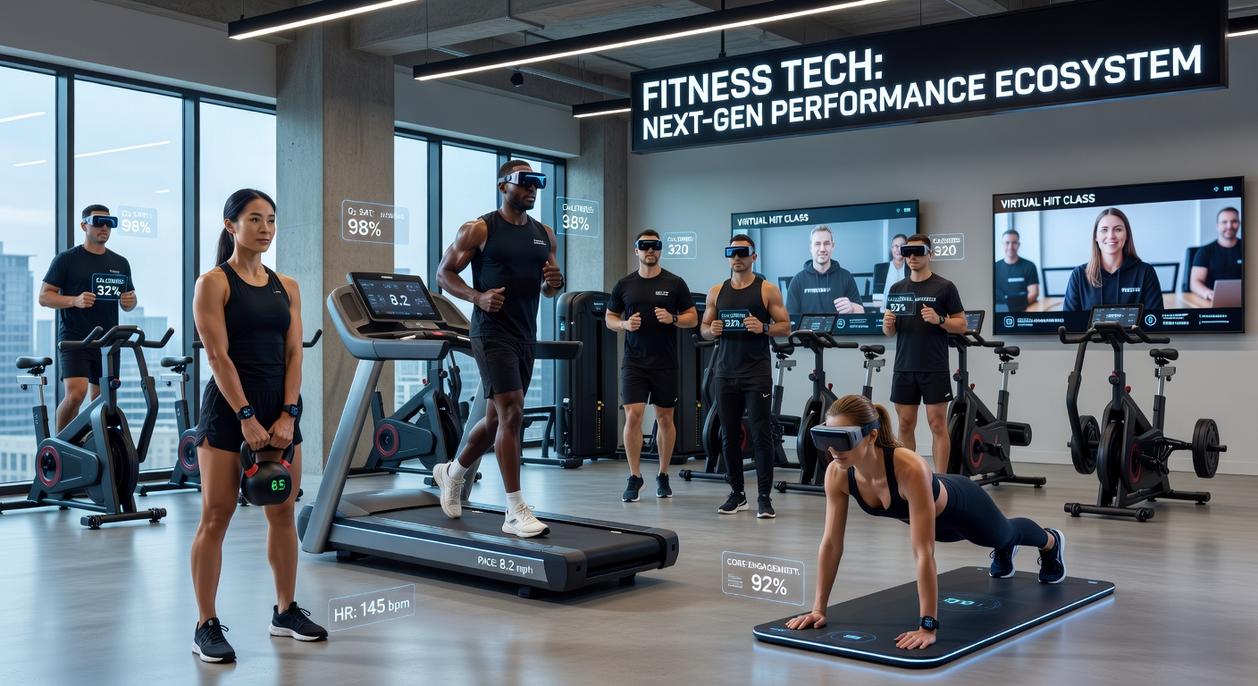
Your smartwatch collects data. Your phone tracks steps. Your fitness app logs workouts.
But here’s what most people don’t realize.
These tools aren’t just recording anymore. They’re thinking.
I’m talking about AI coaching that actually knows you. Not the kind that spits out the same workout plan for everyone who clicks “beginner.” I mean software that looks at your sleep from last night, notices your heart rate variability is down, and suggests you skip the HIIT session today. In the ever-evolving landscape of fitness, the emergence of Athletic Technology Fntkech promises a revolutionary approach to personalized AI coaching that truly understands your unique needs and adjusts your workouts accordingly.
That’s where we’re headed.
Apps like Whoop and Fitbod are already doing this. They pull biometric data and adjust your training in real time. You don’t tell the app you’re tired. It already knows because your recovery score tanked overnight.
Some trainers hate this. They say algorithms can’t replace human intuition. And sure, there’s truth to that. A good coach picks up on things data can’t capture.
But most of us don’t have a personal trainer watching us 24/7. We have an app that does.
The real power comes when everything talks to each other. Apple Health and Google Fit act like command centers for your body’s data. Your running app feeds into your sleep tracker. Your nutrition log connects to your workout planner. Suddenly you’re not looking at isolated numbers. You’re seeing patterns.
What’s interesting is how athletic technology fntkech is pushing mental fitness into the mix now. Headspace partners with Nike. Calm shows up in Peloton. The software finally gets what athletes have known forever: your head matters as much as your legs.
Here’s my prediction though.
Within two years, we’ll see apps that don’t just track mood alongside workouts. They’ll adjust your training based on stress biomarkers pulled from wearables. Cortisol high? The app prescribes yoga instead of weights. That’s not science fiction. The tech exists right now through fntkech tech updates by fitness-talk.
And the community piece? That’s the secret sauce nobody talks about enough.
Strava turned solo runs into social events. Zwift made indoor cycling weirdly fun because you’re racing real people. The software creates accountability without you asking for it. (Nothing motivates like seeing your friend crush a 5K while you’re still on the couch.)
The apps that win won’t be the ones with the most features. They’ll be the ones that make you actually want to open them tomorrow.
On the Horizon: What’s Next in Fitness Technology?
Your smartwatch is about to look outdated.
I’m not saying that to make you feel bad about your current setup. But the next wave of fitness tech is going to make wrist-based tracking feel like using a flip phone.
Let me show you what’s coming.
Biosensor Clothing
Forget strapping devices to your wrist. Smart fabrics are here, and they’re getting better fast.
These aren’t just shirts with sensors sewn in (though that’s where it started). We’re talking about actual fabric that reads your heart rate, breathing patterns, and muscle activity while you move.
The accuracy? Way better than what you get from your wrist. According to fntkech tech updates by fitness-talk, some prototypes are already matching medical-grade equipment.
Advanced Nutrition Tracking
Here’s where it gets interesting.
Scientists are working on sensors that analyze your sweat and breath in real time. No blood draws. No food logging apps.
You finish a run, and the sensor tells you exactly what your body needs. Not generic advice. Actual data about your hydration levels and nutrient depletion.
Some critics say this tech is too invasive or unnecessary. They argue that traditional nutrition tracking works fine if you’re consistent. And sure, food journals can work if you stick with them.
But most people don’t. That’s just reality. This ties directly into what we cover in Fntkech Technoly News From Fitnesstalk.
True AI Personalization
This is the part that actually excites me.
Right now, your fitness app suggests workouts based on basic patterns. Tomorrow’s AI will explain why you should skip that HIIT session because your sleep was terrible and your stress markers are high. As we look ahead to the future of personalized fitness, the latest Technology Updates Fntkech reveal that advanced AI will soon analyze our daily well-being in real time, providing tailored workout recommendations that adapt to our sleep quality and stress levels.
It won’t just say “rest day.” It’ll tell you what to do instead based on the last 24 hours of your life.
That’s not science fiction anymore. It’s just a matter of time.
Integrating Tomorrow’s Tech Into Today’s Workout
You now know what’s coming in fitness technology.
The real challenge isn’t finding new gadgets. It’s figuring out which ones actually matter for your training.
Most fitness tech ends up collecting dust because it doesn’t give you anything useful. You need tools that provide personalized data and real-time feedback you can act on.
Generic workout plans don’t cut it anymore. The tech we covered today helps you move past that.
Here’s what to do: Look at one piece of fitness tech you’re using right now. Ask yourself if you actually use the data it gives you. If the answer is no, it’s time to upgrade.
The innovations we discussed aren’t just cool features. They’re tools that help you understand your body better and train smarter.
fntkech tech updates by fitness-talk keeps you informed on which technology delivers real results. We test the gear and break down what works.
Your next workout should be smarter than your last one. The right tech makes that happen.
 Syrelia Zentha writes the kind of technology news and updates content that people actually send to each other. Not because it's flashy or controversial, but because it's the sort of thing where you read it and immediately think of three people who need to see it. Syrelia has a talent for identifying the questions that a lot of people have but haven't quite figured out how to articulate yet — and then answering them properly.
They covers a lot of ground: Technology News and Updates, Emerging Tech Trends, Expert Opinions, and plenty of adjacent territory that doesn't always get treated with the same seriousness. The consistency across all of it is a certain kind of respect for the reader. Syrelia doesn't assume people are stupid, and they doesn't assume they know everything either. They writes for someone who is genuinely trying to figure something out — because that's usually who's actually reading. That assumption shapes everything from how they structures an explanation to how much background they includes before getting to the point.
Beyond the practical stuff, there's something in Syrelia's writing that reflects a real investment in the subject — not performed enthusiasm, but the kind of sustained interest that produces insight over time. They has been paying attention to technology news and updates long enough that they notices things a more casual observer would miss. That depth shows up in the work in ways that are hard to fake.
Syrelia Zentha writes the kind of technology news and updates content that people actually send to each other. Not because it's flashy or controversial, but because it's the sort of thing where you read it and immediately think of three people who need to see it. Syrelia has a talent for identifying the questions that a lot of people have but haven't quite figured out how to articulate yet — and then answering them properly.
They covers a lot of ground: Technology News and Updates, Emerging Tech Trends, Expert Opinions, and plenty of adjacent territory that doesn't always get treated with the same seriousness. The consistency across all of it is a certain kind of respect for the reader. Syrelia doesn't assume people are stupid, and they doesn't assume they know everything either. They writes for someone who is genuinely trying to figure something out — because that's usually who's actually reading. That assumption shapes everything from how they structures an explanation to how much background they includes before getting to the point.
Beyond the practical stuff, there's something in Syrelia's writing that reflects a real investment in the subject — not performed enthusiasm, but the kind of sustained interest that produces insight over time. They has been paying attention to technology news and updates long enough that they notices things a more casual observer would miss. That depth shows up in the work in ways that are hard to fake.